 Earth Art in Oregon
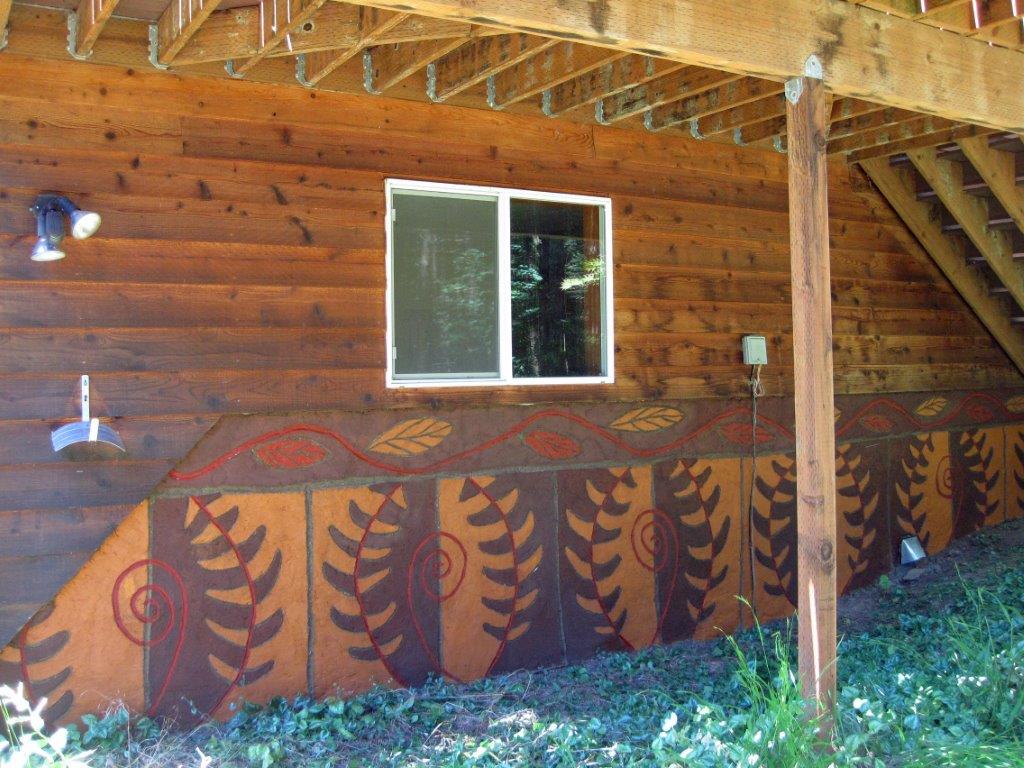
Maia Fischler and friends made this mural on Maia’s house using local earth and powdered concrete tints mixed with waterglass. Maia said “I hadn’t planned to paint the brown areas but as time wet by the mud turned a pretty boring color so I decided to do it at the last minute. Sadly, [the masonry supply place] was closed for the weekend, so I went to Home Depot and got some liquid concrete tint, which wasn’t as nice. (You couldn’t control the consistency so it was pretty runny when mixed — a little less than 1 to 1 — with the waterglass.)
Beautiful work! Her account follows…
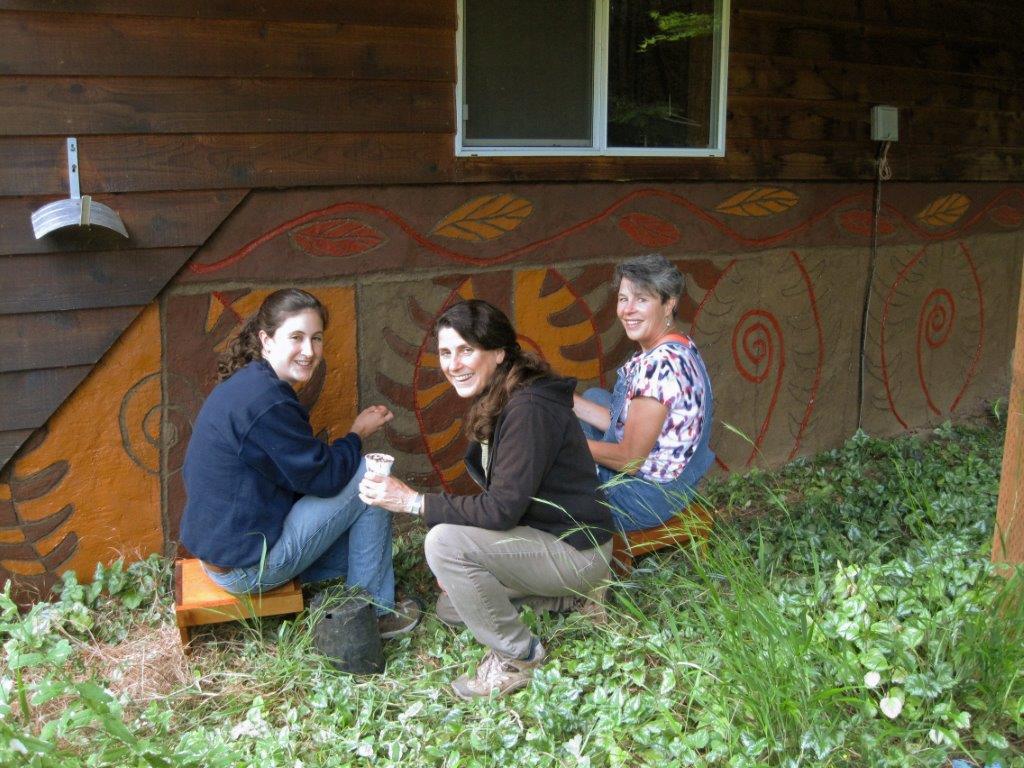
Maia Fischler and friends working on their mural
Maia and the Mudders Make a Mural
Six hardy women, ages 23 to 77, gathered to celebrate Maia’s birthday by transforming an ugly concrete wall (about 4’x20’) into a fabulous mud mural, inspired by Kiko Denzer’s work at Hoover School in Corvallis, Oregon.
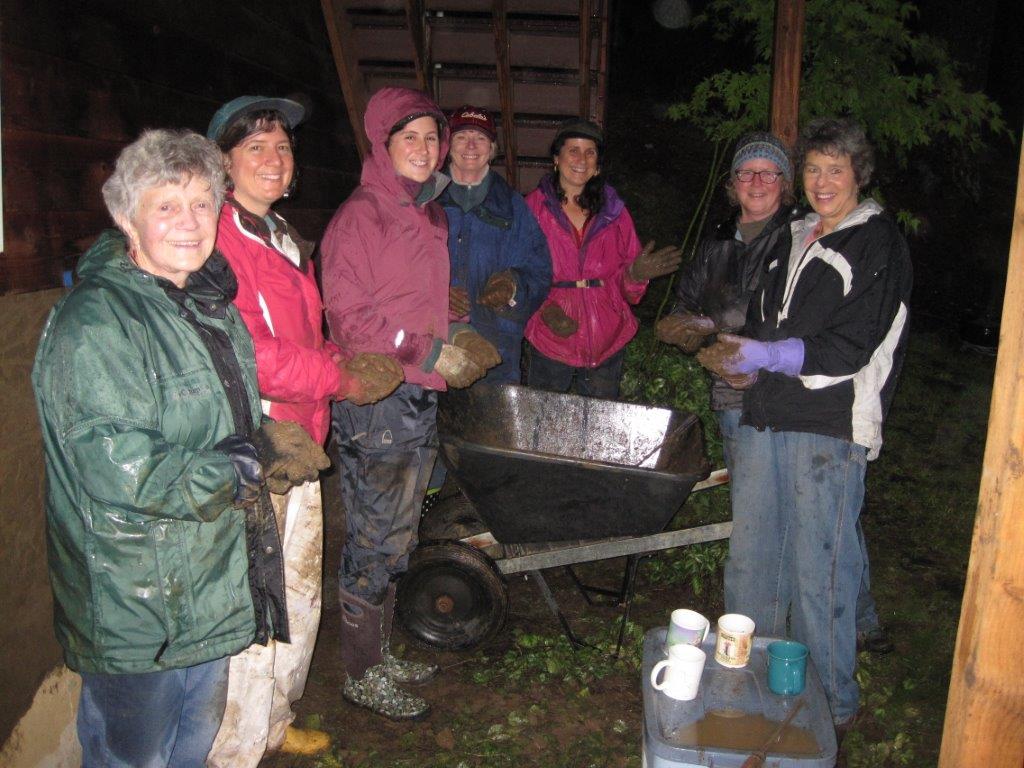 The event had been on the calendar for a long time when we learned that rain and wind were in the forecast for the weekend (locals will grimly remember Fall Festival 2013!) but we decided to push on, given how hard it would be to find another date that meshed for six busy women. We covered the deck above the wall with a huge tarp to create a kind of roof, and it worked pretty well.
We were assisted by two helpful husbands who did most of the mixing of the materials. (In our pre-storm vision, their role was to be cabana boys, serving tropical drinks to the workers. They delivered hot toddies instead.)
We had gathered the materials beforehand: clay from the back yard, sand from a landscape supply place, and mint compost, which we happened to have on hand. We mixed the batches in a wheelbarrow, roughly one 5-gallon bucket of clay to two 5-gallon buckets of sand to a gallon of mint compost. The clay was wet enough that we didn’t have to add much water. Like concrete, you mix and mix and suddenly something happens and it’s the perfect consistency. Mud magic.
The mud stuck to the concrete wall quite well, once we got the hang of slapping it on and troweling it flat. The whole mudding process took 3-4 hours. It was pretty raucous and fun – as any event combining women and mud should be – and the team was for the most part cheerfully oblivious to the typhoon conditions outside our little muddy tarp-room.
We carved the design while the mud was still quite wet (which it stayed for a couple of days thanks to the weather.) Maia had created the design beforehand, inspired by the mirrored pattern examples in Kiko’s “Dig Your Hands in the Dirt†book. She integrated some of her favorite motifs, spirals and fern leaves, and tried a few different color/contrast combinations on paper first. Then she scanned the design and played with it using Photoshop (an option for high-tech types – not at all necessary!)
The first step was to carve the straight horizontal and vertical lines to define the smaller spaces. (Before beginning the mudding, we had used masking tape on the cedar siding to mark where the lines would be.) We carved the design on lightly, free-hand, and then broadened and deepened the lines. Then we left it and headed indoors to clean up, dry out, and eat some well-earned dinner and birthday cake.
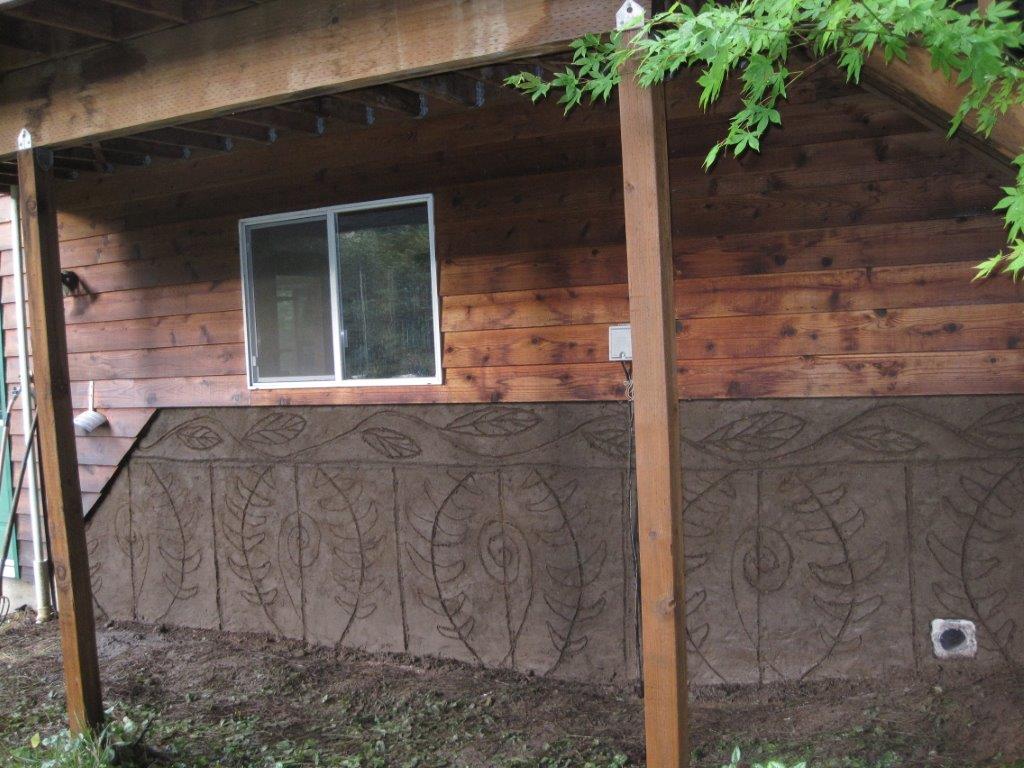
About a week later, Maia applied two light coats of waterglass (sodium silicate), which she had purchased in gallon jars from a clay/ceramics dealer. She used about a half gallon all together, mixing it 1:1 with water and spraying it on the wall using a garden spray canister.
We had good intentions of getting back together in a few weeks to paint the wall, but because of weather and schedules, the opportunity didn’t come till about six months later. By then the wall had hardened to a seriously concrete-like texture.
For the orange and reddish-orange paint, we used dry concrete tint purchased at a local building supply store, mixed 1:1 with waterglass. It was very nice to work with, kind of like the old poster paints you used in elementary school. For the brown, we used some liquid concrete tint purchased at Home Depot, which wasn’t as nice. (You couldn’t control the consistency so it was pretty runny when mixed — a little less than 1:1 — with the waterglass.)
All in all, it was a fun, fast, easy process, and we’re delighted with the results. We’re ready to move on to another team member’s backyard for the next project — but this time we’d like a little sunshine!
Leave a Reply