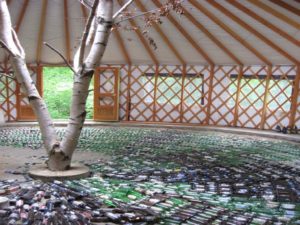
Rusty Orner, of Quiet Creek Farm, in PA, took the idea of insulating an oven floor with recycled beer bottles and applied it to a yurt he was building as a classroom and bunk space for students and interns. On leveled ground, they made a rubble trench, covered with gravel bags and capped with mortar and slate, to support the lattice walls of the yurt. They filled the thirty foot diameter donut with packed shale, a thin layer of sand, and then 5,000 beer bottles. The empty bottles provide four inches of insulation and a thermal break to keep cold from migrating into the floor. Rusty . . .
Wood-fired oven recipes: Hameen Eggs
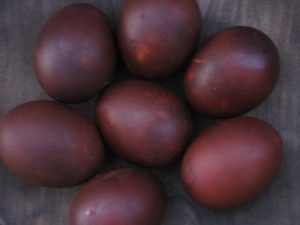
I don't normally get excited about hard-boiled eggs, but these aren't your normal fare. The color alone gives them a quality like deeply polished mahogany; the flavor is nutty and sweet; the texture of the white is firmer, while the yolk is softer. The trick is simply to boil them gently with onion skins, overnight, in the declining heat of your oven. Red onion skins give a deeper color -- these were cooked with white onion skins. I forget who got us started with these, but when I went looking on the web I found many references to "hameen" dishes -- so-called simply because they were . . .
Wood-fired earth ovens: experiments in DIY firebrick (aka “castable refractory”)
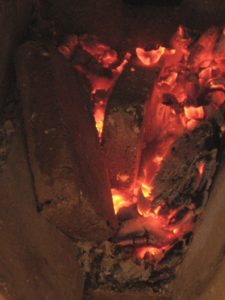
I've been experimenting with cheap ways to improve lo-cost wood-fired earthen ovens. How can I make mud denser, harder, and more durable? Without going to bricks and/or spending a lotta dough? Adding sand to mud reduces shrink and increases density. But clay and sand are generally still less dense (hold less heat) than a good, hi-fired dense firebrick. Hmmm... Experimental Goals: 1. to increase the density and toughness of a clay/sand thermal mix appropriate for building wood-fired ovens (and other wood-fired appliances?), 2. to fabricate a higher quality cast dome ("earth-oven") style . . .