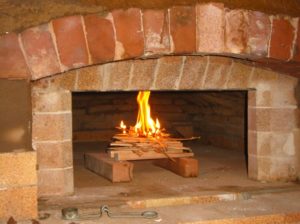
You can greatly improve how your oven performs by how you lay and manage the fire. Here's how and why I build what Pat Manley calls "an upside down fire." (Follow the link to an overlong video version). The first principle of fire requires applying to heat to fuel. When the fuel gets hot enough, it bursts into flame. But if you pile many pounds of wood on top of your kindling, it will take a long time before all your fuel can really start burning. Meanwhile, you'll get a lot of smoke in your (and possibly your neighbors') eyes, and you'll lose a lot of fuel (all that smoke counts as unburnt . . .
The Cob Oven FAQ
Q: what's the difference between a cob oven and an earth oven? A: Usually, they mean the same thing, but sometimes when people say earth oven, they mean a simple pit oven, like a Fijian lovo or Samoan 'umu. Q: How efficient are cob ovens? A: There are two things to consider here. First, since you have to heat up the whole mass of a retained heat oven in order to bake, clearly, cooking just a few loaves of bread won't make efficient use of all your fuel. However, the more you cook, the more of the stored heat you use up, and the better your efficiency. Insulating an oven increases efficiency . . .
Two-tier yurt with Bill Coperthwaite
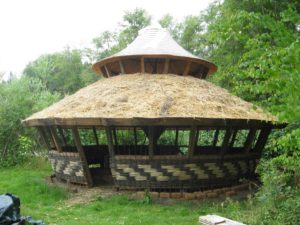
Here's the lovely, two-tier yurt that Bill Coperthwaite helped us build in October of '09. (And here are my followup explorations that adapted the design by going back to traditional sticks and basket as well as incorporating earthen plasters -- simpler to build, and better performance and comfort in wetter climates.) It's on the grounds of the Ancient Arts Center near Alsea, just a long leap over a couple of ridges, into the next drainage south of us (the Alsea River). We finished the woven willow and mud walls in May of '09. If you want to come help, we'll be having more workshops . . .