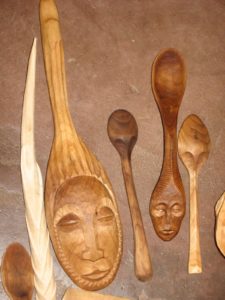
carved from green wood: roughed out with a hatchet and/or a northwestern style adze, then shaped and finished with crooked knives and a straight blades (click on the thumbnail for an uncropped view of the entire photo). Some of the detail work is done w/little burins. The bowls I carved with a crooked knife, straight blade, and a neat jig designed by Bill Coperthwaite (author of A Hand Made Life). Bill's spoon is the little yellow (birch) ladle with the scooped indents where the handle meets the bowl -- his addition to the tradition of spoon design. After I started carving spoons, a friend . . .
Teaching with Mud, Sand, and Straw
Working with mud, sand, and straw is a way to teach geology, engineering, physics, history, drawing, composition, and design. It is also a way to teach social skills, like cooperation. But more important than just what it teaches is how it teaches: Jon Young is a wilderness educator who takes kids into the woods, and teaches them to identify and track wildlife, among other things. He cites Microsoft research suggesting that tracks in the mud were an original source of writing, that alphabets are like birdprints, and that reading a set of tracks, from a brain science point of view, is the . . .
Adding masonry to increase wood stove efficiency
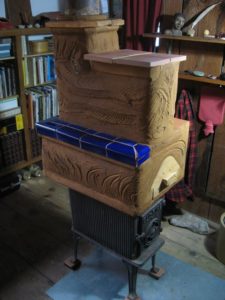
Adding masonry to increase wood stove efficiency By adding masonry and mud to an old cast-iron wood stove, I greatly increased its efficiency -- and it even has an oven! (note the wooden door on the right, just above the iron stove door). The wood that used to over-heat me, briefly, in the morning, now keeps me comfortably warm all day, and into the next morning (depending on how long I fire it and how cold it is). And, unlike most iron stoves, it no longer generates that fierce, dry heat that you can only moderate by burning wet wood, or by damping the fire down to a messy, smoldering . . .